A Week of Cracked Foundations: Railway, PHP2Shell, and the eMudhra Incident
Three critical security failures converged in a single week: stolen cloud secrets at Railway, an unauthenticated parser exploit in PHP, and broken entropy at a major Certifying Authority.
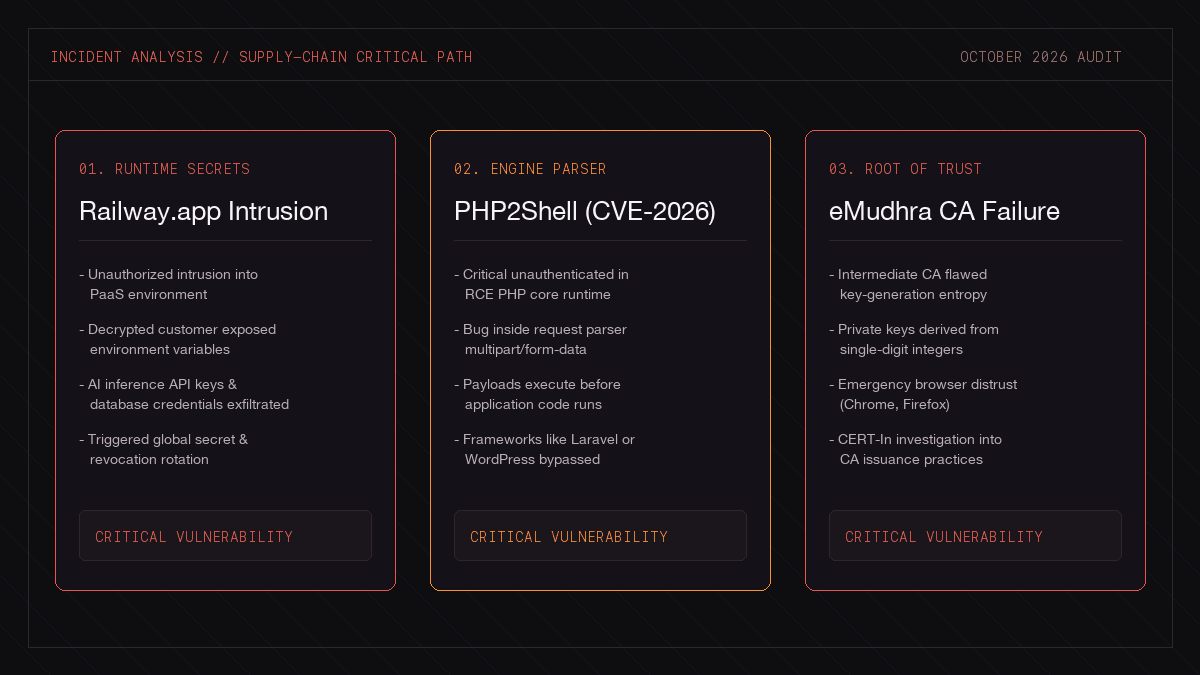
Every few years, the tech industry experiences a chaotic week where multiple layers of the foundational stack fail at the exact same moment.
October 2026 delivered one of those moments.
Within days of each other, developers and security engineers woke up to three simultaneous crises: an unauthorized intrusion into Railway.app targeting cloud environment variables, a catastrophic Remote Code Execution vulnerability in the core PHP runtime known as PHP2Shell, and an unprecedented key-entropy failure inside eMudhra, a major digital Certifying Authority.
None of these incidents were connected by a single threat actor. Yet taken together, they revealed how much of the modern web relies on implicit trust in secret storage, legacy parsers, and public-key infrastructure.
Here is what actually happened across all three fronts, and what engineering teams must learn from them.
1. The Railway.app Intrusion: The Hunt for Runtime Secrets
The modern platform-as-a-service (PaaS) promise is simplicity: connect a GitHub repository, define your environment variables in a web dashboard, and let the platform orchestrate deployment.
That trust was shaken when Railway disclosed an unauthorized access incident affecting internal systems. Attackers gained access to customer environment variable stores, including decrypted secrets for select production deployments.
What made this attack particularly alarming was what the adversaries were targeting. Rather than defacing sites or launching ransomware, the attackers systematically harvested high-value credentials:
- AI Inference Tokens: API keys for OpenAI, Anthropic, and Google Gemini with high billing quotas, which can be immediately liquidated or used to run unauthorized inference workloads.
- Database Connection Strings: Production database credentials containing user tables and sensitive data.
- Private Container Registry Credentials: Giving attackers the ability to inspect proprietary backend codebases.
Railway took swift action by notifying users, revoking compromised internal tokens, and urging teams to rotate every secret in their dashboard. The incident highlighted a harsh reality: storing long-lived, plaintext secrets in centralized cloud dashboards creates an irresistible honeypot for adversaries.
2. PHP2Shell (CVE-2026-109618): When the Core Parser Crumbles
While cloud engineers were rotating API keys, backend teams maintaining legacy and modern web services were hit by PHP2Shell.
Disclosed under CVE-2026-109618 and CVE-2026-109619 with a CVSS score of 9.2, PHP2Shell is an unauthenticated Remote Code Execution vulnerability residing directly inside the PHP core runtime.
The flaw lies inside the multipart/form-data request parser. When a web server receives an HTTP POST request with an uploaded file, the PHP runtime parses the incoming stream before any user code, framework middleware, or application routing ever executes. Due to improper state cleanup and memory corruption in the parser, a specially crafted multipart payload could execute arbitrary shell code straight out of the socket.
Because the vulnerability existed in the underlying C engine interpreting web traffic, application-level security features provided no defense:
- Framework sanitization in Laravel or Symfony did not help because the bug triggered before the framework booted.
- Web Application Firewalls (WAFs) struggled to catch polymorphic multipart variations without breaking legitimate file uploads.
The only real fix was emergency patching of the PHP binary itself. For organizations running legacy containers or outdated distributions, it was a terrifying reminder that our applications are only as secure as the C code parsing their raw HTTP packets.
3. The eMudhra CA Breakdown: When Cryptographic Math Fails
As if platform breaches and runtime RCEs were not enough, the week culminated in a root-of-trust crisis involving eMudhra, a globally recognized Certifying Authority responsible for issuing digital certificates across enterprise, banking, and government infrastructure.
Security researchers identified an astonishing vulnerability in the key-generation pipeline for intermediate certificates under the emSign Root CA architecture.
Public-key cryptography relies on the mathematical impossibility of deriving a private key from a public certificate, assuming keys are generated with true cryptographic entropy (randomness). In eMudhra's case, an implementation flaw in their key-generation entropy source meant that the private keys for certain intermediate certificates could be mathematically factored in minutes. In some verified cases, private keys were derived from single-digit integers.
With access to the private key of an intermediate CA, an attacker can issue valid, trusted SSL/TLS certificates for any domain on the internet without detection.
The fallout was immediate:
- Google Chrome, Mozilla Firefox, and major operating system vendors moved rapidly to distrust the compromised intermediate certificates from their global root trust stores.
- India's CERT-In and regulatory bodies initiated urgent audits into certificate issuance workflows.
- Thousands of enterprise portals and government platforms faced certificate warning screens until emergency re-issuance was completed.
The Lessons for Modern Engineering
When an entire week of infrastructure breaks at once, it forces a sober assessment of engineering practices. Three key takeaways stand out:
1. Kill Long-Lived Static Secrets
Static API keys living in environment variable dashboards are an anachronism. Infrastructure should move toward short-lived, identity-based credentials (such as AWS IAM Roles for Service Accounts or OIDC token exchange) that automatically expire within hours.
2. Runtime Isolation Is Not Optional
You cannot assume your application language runtime is invincible. Running application processes with read-only root filesystems, non-root user permissions, and strict egress firewalls ensures that even if an engine-level parser like PHP2Shell is exploited, the payload cannot execute external binaries or dial out to command-and-control servers.
3. Trust, but Actively Verify Your Certificate Supply Chain
Digital trust is not permanent. Organizations must monitor their Certificate Transparency logs continuously so they are notified the instant an unauthorized certificate is minted for their domain.
The internet works because thousands of invisible, interconnected layers work in harmony every second. When three of those layers wobble simultaneously, it is an urgent reminder to build software that assumes failure from the foundation up.