The Inference Inversion: Why Serving AI Is Eating Training Alive
Training captured the headlines and venture budgets for years. Now, test-time compute, agentic loops, and memory bandwidth limits have flipped the entire economic equation.
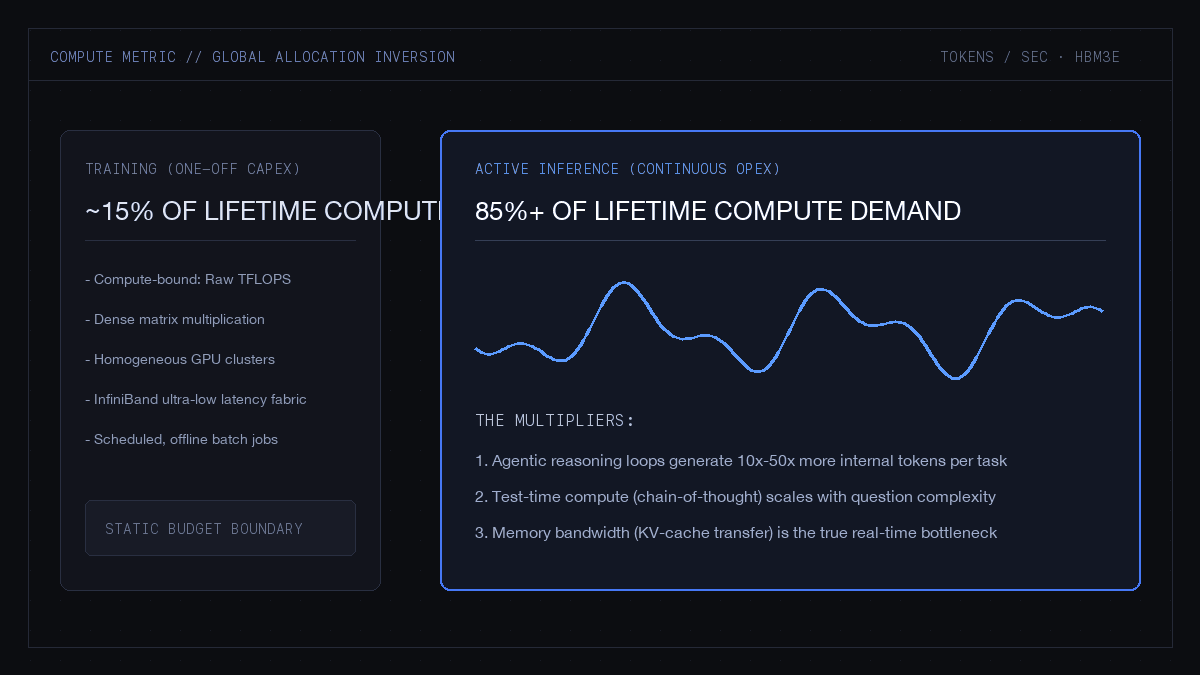
For the last three years, the dominant narrative in artificial intelligence was training compute. Frontier labs fought over 50,000-GPU clusters, negotiated multi-gigawatt power contracts, and treated pre-training as the ultimate moat. A single training run cost tens of millions of dollars, so that was where the attention and venture capital flowed.
Quietly, that equation has inverted.
Inference has overtaken training in active workloads, power draw, and enterprise spend. While training a frontier model remains a massive one-off capital expenditure, running that model in production for millions of users around the clock means that inference accounts for over 85 percent of all compute cycles across the model's operational lifetime.
The industry has entered the era of the inference bottleneck. Understanding why requires looking closely at how AI usage has fundamentally changed.
1. The Token Multiplier: From Simple Chat to Agentic Loops
In 2023, the standard interaction was a simple question and answer. You gave the model 150 prompt tokens, and it responded with 300 output tokens. A single HTTP request, a quick forward pass, and the interaction was finished.
Today, real-world AI applications operate in autonomous agentic loops. When an engineer asks an agent to diagnose a failing test suite or refactor a module, the agent does not generate one response. It reads twenty source files, plans a strategy, runs a terminal command, parses compiler errors, critiques its own output, and iterates.
What looked like a single user request can trigger thirty underlying model calls and consume over 50,000 tokens before the user sees a single result.
When you add test-time reasoning models to the mix, this volume multiplies again. These models generate thousands of hidden tokens in an internal scratchpad, verifying mathematical logic and backtracking when a path fails. The user sees a concise two-sentence answer, but the data center had to process ten thousand intermediate reasoning tokens to arrive at it.
The net result is that token demand is no longer scaling linearly with user growth. It is scaling exponentially with problem complexity.
2. The Hardware Reality: Compute-Bound vs Memory-Bound
The reason serving inference at scale is so difficult comes down to computer architecture. Training and inference are fundamentally different physical problems.
Pre-training is compute-bound. You feed dense batches of millions of tokens into massive matrix multiplication engines. GPUs can run at maximum floating-point capacity (TFLOPS) because the arithmetic intensity is high.
Autoregressive inference, in contrast, is memory-bandwidth bound. To generate just one token, the accelerator must load billions of model weights from High Bandwidth Memory (HBM) into on-chip cache. For every single token generated, the memory bus is saturated. The processor spends most of its time waiting for bytes to travel across silicon rather than performing calculations.
This is why traditional training clusters cannot simply be repurposed for low-latency inference without massive financial waste. It is also why hardware like Groq's LPUs, custom enterprise ASICs, and Apple's unified memory architectures have gained so much momentum. When memory throughput is the bottleneck, raw compute specs are no longer the winning metric.
3. The Rise of Inference FinOps
Because inference costs recur every single time a user clicks a button, high token bills have become the single biggest threat to software margins. In response, engineering teams have had to invent an entirely new discipline: Inference FinOps.
Several architectural patterns have quickly become standard:
- Multi-Model Tiering: Routing straightforward user queries to fast, quantized 8B parameter models, reserving frontier reasoning models only for high-complexity tasks.
- Aggressive Quantization: Moving weights from FP16 down to INT8 and FP4 precision with minimal loss in reasoning quality, cutting memory bandwidth requirements in half.
- Speculative Decoding: Using a tiny draft model to propose tokens rapidly, while a larger model verifies multiple tokens in parallel in a single forward pass.
- Persistent KV-Cache Optimization: Compressing and sharing key-value cache states across multi-turn conversations so identical context does not need to be recalculated from scratch.
What This Means for Product Builders
For software developers, this shift changes where product leverage lives.
When training was the only differentiator, advantage belonged exclusively to the few organizations that could afford nine-figure compute budgets. In an inference-dominated world, the advantage shifts to product engineers who master orchestration, prompt caching, latency budgets, and local-first execution.
The future of software is not just about who trains the biggest model. It is about who can serve intelligence reliably, affordably, and quietly at the point of need.